Intelligent Optimization Strategy Based on Statistical Machine Learning for Spacecraft Thermal Design
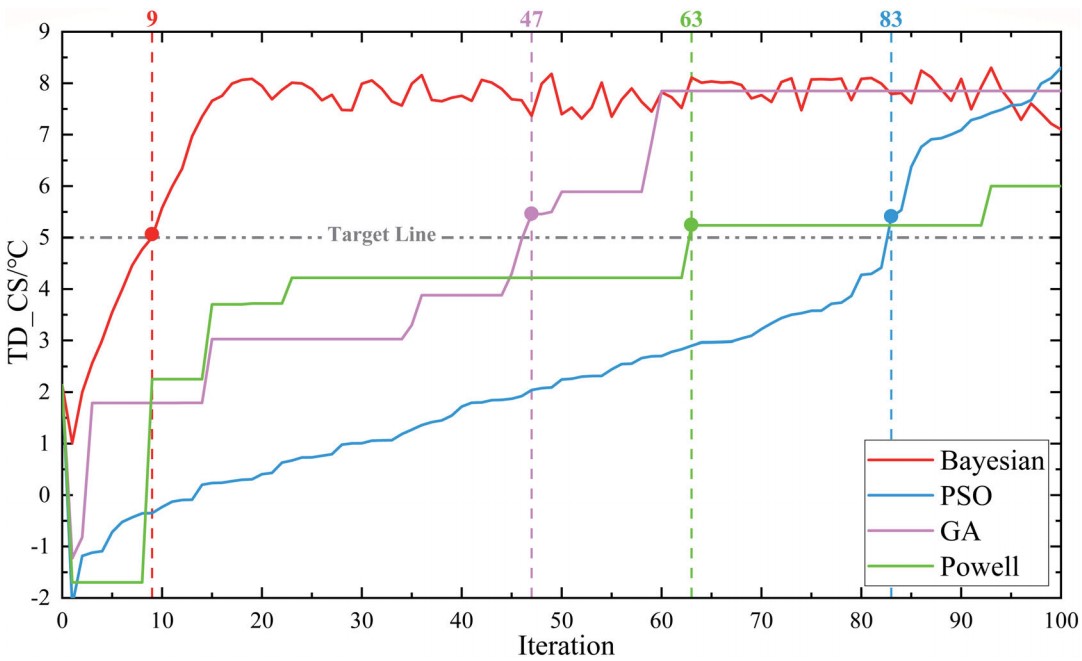
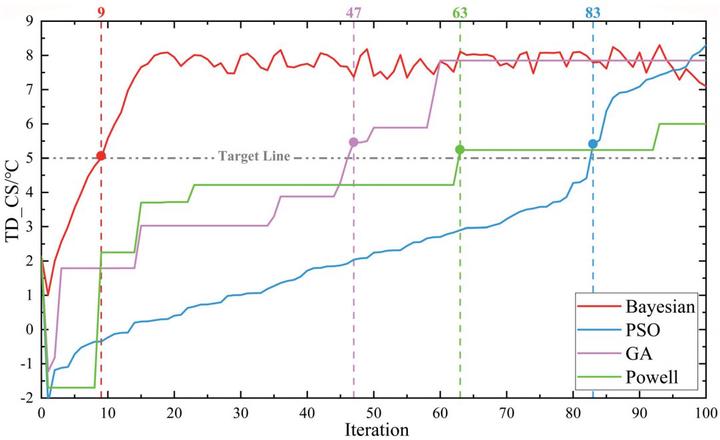 Performance: Bayesian
Abstract
The thermal design of spacecraft becomes increasingly complicated as various advanced technologies are continuously introduced to the spacecraft. Determining and optimizing the uncertainties of a spacecraft thermal control system through global sensitivity analysis has long been an essential task for thermal engineers. It is a difficult task that relies heavily on engineering experience and is a time-intensive, trial-and-error endeavor that may not even lead to global optimization. Hence, an intelligent optimization strategy based on statistical machine learning for spacecraft thermal design, called IOSML, is proposed. An intelligent batch processing system (IBPS) based on MATLAB, Python, and NX/TMG real-time data interaction is designed. The IBPS uses a surrogate model to reduce the computational cost of global sensitivity analysis while using a detailed thermal mathematical model to maintain accuracy. We combine a Bayesian inference framework with a neural network surrogate spacecraft-thermophysical model that is 100+ times faster than numerical solvers. This article first reports on a density-based global sensitivity analysis that evaluates the effect of design parameters on the temperature difference between the complementary metal–oxide–semiconductor and cold screen of the Lehman Alpha Solar Space Telescope detector. From 42 design parameters, the most sensitive four are selected for optimization, and the temperature difference and the boundary temperature are used as the objective function. Adopting IOSML, under no supervision, four design parameters are optimized through the IBPS, and the effectiveness of the algorithm is verified by comparison with traditional methods. Additionally, IOSML is versatile and can be used in various complex engineering applications to provide guidance for the better selection of appropriate parameters and optimization.
Supplementary notes can be added here, including code, math, and images.

Yan XIONG(熊琰)
Ph.D. student from the University of Chinese Academy of Sciences
My research interests include intelligent control of gyroscopes using model-based reinforcement learning, intelligent thermal control based on deep reinforcement learning for space load, and engineering applications of AI, such as robotic systems, spacecraft strategic planning, etc.